Philosophy
What Patanjali's Yoga Sutras Say About Pranayama (2.49–2.53)
A plain-English guide to pranayama in Patanjali's Yoga Sutras: the definition in 2.49, the three movements of the breath in 2.50, the mysterious fourth pranayama in 2.51, and what the practice leads to in 2.52–2.53.
Somashekar
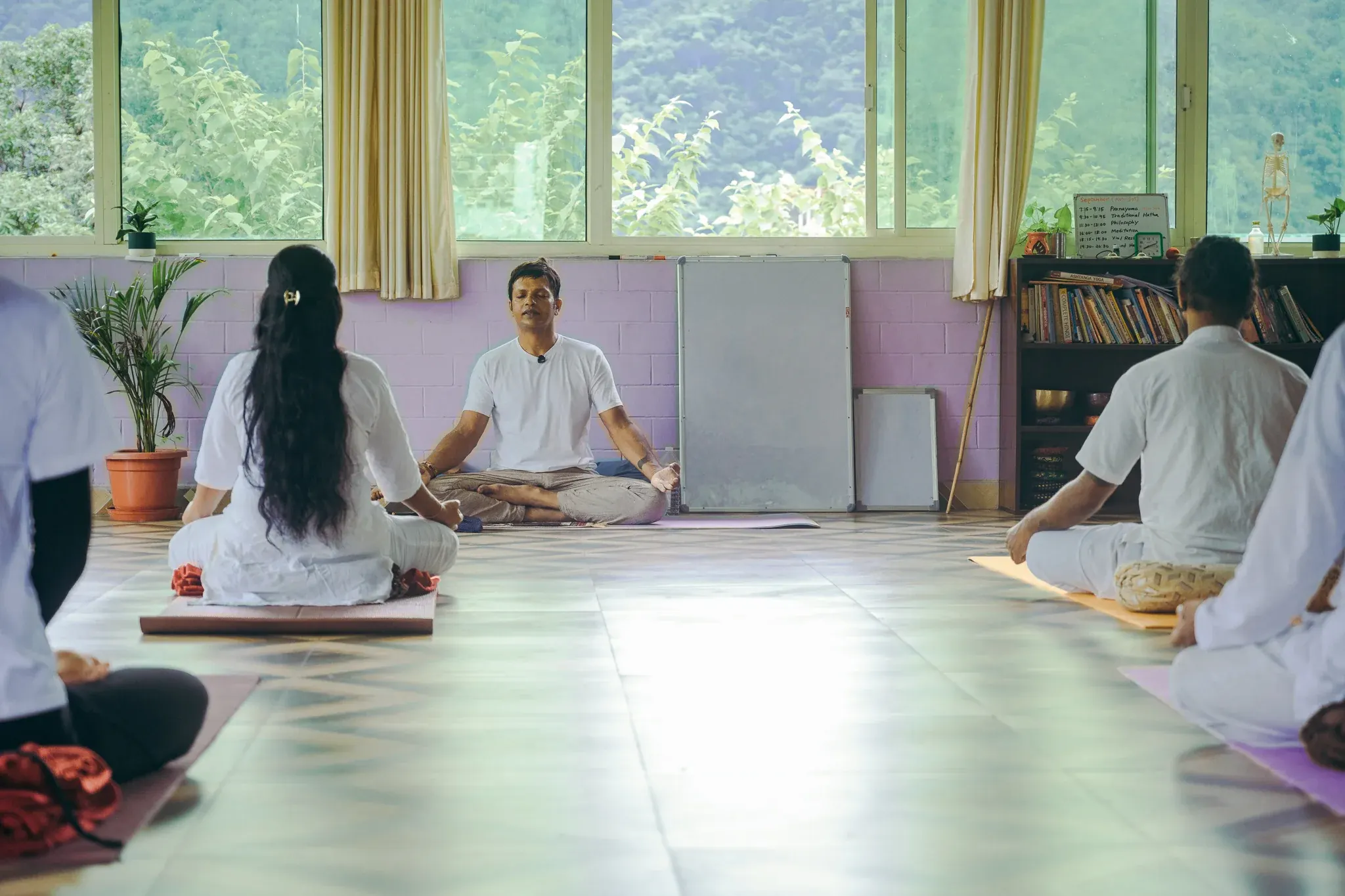
Written by Somashekar, founder and head teacher of Anantadrishti Yoga. Disclosure: the course mentioned at the end is our own.
Patanjali's Yoga Sutras is the text most people mean when they say "yoga philosophy". It says remarkably little about the breath: five short sutras in the second chapter, and one earlier hint in the first. Yet those few lines shape how pranayama is understood to this day. This guide goes through them one by one, in plain English, and shows how they meet a practice on the mat. It is a summary, not a translation; to study the text closely, read it in a good edition with a traditional commentary.
At a glance
| Sutra | Key Sanskrit words | What it says, in substance |
|---|---|---|
| 1.34 | pracchardana, vidharana | The mind can also be calmed by exhaling and holding the breath out |
| 2.29 | ashtanga | Pranayama is the fourth of the eight limbs |
| 2.46–2.48 | sthira, sukha | First, a seat that is steady and comfortable |
| 2.49 | shvasa, prashvasa, gati-viccheda | Pranayama is the regulation of the flow of inhalation and exhalation |
| 2.50 | bahya, abhyantara, stambha; desha, kala, sankhya | Outer, inner and held breath, observed by place, time and number, become long and subtle |
| 2.51 | chaturtha | A fourth pranayama goes beyond the outer and inner |
| 2.52 | prakasha, avarana | The covering over the inner light diminishes |
| 2.53 | dharana, yogyata | The mind becomes fit for concentration |
Numbering follows the standard four-chapter text. Translations of individual words vary.
What are the Yoga Sutras?
The Yoga Sutras is a compact classical text on yoga attributed to Patanjali, made of about 195 short aphorisms in four chapters. The chapters are on absorption (samadhi), practice (sadhana), accomplishments (vibhuti) and liberation (kaivalya). Scholars date it variously, most often to the early centuries CE. A sutra is a "thread": a condensed line meant to be unpacked by a teacher or a commentary, and the oldest surviving commentary, attributed to Vyasa, is still the usual starting point. That is why one sutra can carry several readings, and why the few lines on pranayama repay slow study.
The Sutras is a text about the mind. Its famous second sutra defines yoga as the stilling of the movements of the mind (1.2). Everything it says about the breath serves that aim. Our guide to the eight limbs of yoga sets out the full path.
Where does pranayama sit among the eight limbs?
Pranayama is the fourth of Patanjali's eight limbs, the hinge between body and mind. Sutra 2.29 lists them: yama (restraints), niyama (observances), asana (posture), pranayama, pratyahara (withdrawal of the senses), dharana (concentration), dhyana (meditation) and samadhi (absorption). The first three steady your conduct and your body. The last four turn attention inward. Pranayama sits between them because the breath belongs to both: it is physical, and it mirrors the state of the mind.
The sutras just before pranayama set the condition. Asana is a seat that is steady and comfortable (2.46), refined by relaxing effort and resting attention on the infinite (2.47), so that the practitioner is no longer disturbed by opposites such as heat and cold (2.48). For Patanjali, asana means above all the seat for breath practice and meditation.
How does Yoga Sutra 2.49 define pranayama?
Sutra 2.49 defines pranayama as the regulation of the flow of inhalation and exhalation once the seat is established. The Sanskrit is tasmin sati shvasa-prashvasayor gati-vicchedah pranayamah. "Tasmin sati" means "that being accomplished", referring back to asana. "Shvasa" is the in-breath, "prashvasa" the out-breath, and "gati-viccheda" is the breaking or pausing of their ordinary flow.
Translators disagree over how strong "viccheda" is. Some write "cessation", others "interruption", others "regulation". In practice, these readings point to the same thing: the breath stops running on autopilot. You interrupt the unconscious habit and the breath becomes deliberate, which includes, at times, a held pause. The definition doesn't name any technique. It describes a change in your relationship with the breath.
What are the three movements of the breath in 2.50?
Sutra 2.50 says the breath has an outer, an inner and a held movement, and that each becomes long and subtle when observed by place, time and number. "Bahya" is the external phase, the exhalation and the pause after it. "Abhyantara" is the internal phase, the inhalation and the pause after it. "Stambha" is the suspended or held state.
The three measures are practical. Place (desha) is where the breath is felt and directed: the nostrils, the chest, the abdomen, or how far the breath reaches. Time (kala) is the length of each phase. Number (sankhya) is how many rounds you practise. The breath that results is described as "dirgha", long, and "sukshma", subtle or fine. Note the order: length and fineness, not force. A pranayama practice built on this sutra lengthens the breath gradually, counts it, and watches where it moves, which is exactly how breath ratios and retention are taught in a classical class. Our guide to kumbhaka explains the held phases in practical terms.
What is the fourth pranayama in 2.51?
Sutra 2.51 names a fourth pranayama that goes beyond the external and internal spheres, and leaves it unexplained. The Sanskrit is bahya-abhyantara-vishaya-akshepi chaturthah: "the fourth surpasses the domain of outer and inner". The first three movements in 2.50 are things you do. The fourth seems to be something that happens.
Many commentators read it as a spontaneous suspension of the breath that arises in deep absorption, when the mind is so still that the breath settles on its own. Later hatha yoga texts describe something similar as kevala kumbhaka, retention without effort, the fruit of long practice (see our guide to what the Hatha Yoga Pradipika says about pranayama). It is not a target to force. A long hold reached by strain is the opposite of what the sutra describes.
What does pranayama lead to, according to 2.52 and 2.53?
Patanjali gives pranayama two results: the covering over the mind's light thins, and the mind becomes fit for concentration. Sutra 2.52, tatah kshiyate prakasha-avaranam, says that the veil over the inner light, "prakasha", wears away. The commentaries read this veil as the dullness and agitation that cloud clear seeing. Sutra 2.53, dharanasu cha yogyata manasah, adds that the mind becomes fit, "yogya", for dharana, concentration.
The next sutra (2.54) moves on to pratyahara, the withdrawal of the senses. The sequence is the point. Pranayama is not the goal; it prepares the mind for the inner limbs. Anyone who has sat for meditation straight after a slow, steady breath practice has felt the difference. The mind is still active, but easier to gather.
What does sutra 1.34 add?
Sutra 1.34 offers the breath as one way to steady a restless mind. Among several methods for calming the mind, Patanjali lists pracchardana-vidharanabhyam va pranasya: "or by the exhalation and retention of the breath". Read with 2.50, it suggests that a long, smooth exhalation and a gentle pause after it are especially settling. That matches what many practitioners notice, and it is why lengthening the exhale is often taught early.
Does Patanjali teach any breathing techniques?
No: the Yoga Sutras names no breathing techniques at all. You won't find Nadi Shodhana, Bhastrika, Ujjayi or the bandhas in it. Those come from the later hatha yoga tradition, above all the Hatha Yoga Pradipika, which is a practitioner's manual. The two texts complement each other. The Pradipika tells you how to practise; the Sutras tells you what the practice is for and how to recognise when it is refined: longer, subtler, steadier, and leaving the mind clearer.
A word of caution that both texts would share: breath retention places real demands on the body. Anyone who is pregnant, or has high blood pressure, a heart condition, glaucoma, epilepsy or another serious condition, should consult a doctor before practising kumbhaka, and should learn it from a teacher.
How do these sutras show up in a pranayama course?
A classical course puts 2.49–2.53 into practice: a steady seat first, a deliberate breath, gradual lengthening by count, and attention to what the practice does to the mind. At Anantadrishti Yoga, the Advanced Pranayama & Yoga Philosophy Course runs Monday to Saturday. From 07:30 to 09:00 you practise. From 11:30 to 13:00 there are corrections and the science and philosophy of pranayama, drawing on classical texts such as Patanjali's Yoga Sutras and the Hatha Yoga Pradipika. It is not a sutra-by-sutra text study; the ideas are set beside what you observe in your own practice. In every course, students learn to observe how each practice influences the mind, the nervous system, the body and the energies, which is 2.52–2.53 tested on yourself.
There is no separate philosophy course: philosophy is woven into that daily session. Our yoga philosophy page explains the approach, and our guide to yoga philosophy courses in Rishikesh compares the formats you'll find in town.
The course is taught in English, in person, in small groups, near Moktan Coffee Shop in Lower Tapovan, Rishikesh, a short walk from Laxman Jhula and the Ganga. Your teacher is Somashekar, who has devoted more than fifteen years to the study and teaching of yoga, pranayama, yoga philosophy and Vedic chanting. It is a practitioner course, not a teacher training.
If you'd like to study Patanjali's teaching on the breath with daily practice, see the 7-day, 15-day and 30-day options on the course page. Courses start on the 1st of the month (Monday the 2nd when the 1st is a Sunday), tuition starts at US$149, and enquiring costs nothing.
Frequently asked questions
What do the Yoga Sutras say about pranayama?
Patanjali treats pranayama in five sutras, 2.49–2.53. Once a steady, comfortable seat is established, pranayama is the regulation of the movement of inhalation and exhalation (2.49). The breath has external, internal and held phases that become long and subtle when observed by place, time and number (2.50). A fourth pranayama goes beyond the external and internal (2.51). As a result, the covering over the inner light thins (2.52) and the mind becomes fit for concentration (2.53).
What is the definition of pranayama in Yoga Sutra 2.49?
Yoga Sutra 2.49 reads 'tasmin sati shvasa-prashvasayor gati-vicchedah pranayamah'. In substance: when the posture is established, pranayama is the regulation, or pause, of the flow of inhalation and exhalation. Translators render 'gati-viccheda' as cessation, interruption or regulation, which is why English versions differ.
What is the fourth pranayama in the Yoga Sutras?
Sutra 2.51 describes a fourth pranayama that goes beyond the external and internal spheres. Patanjali does not explain it further. Many commentators read it as a natural suspension of the breath that arises without effort in deep absorption, which later hatha texts call kevala kumbhaka.
Where is pranayama among the eight limbs of yoga?
Pranayama is the fourth of Patanjali's eight limbs (2.29), after yama, niyama and asana and before pratyahara, dharana, dhyana and samadhi. It is the bridge between the outer limbs that steady body and conduct and the inner limbs that steady the mind.
Do the Yoga Sutras describe specific breathing techniques?
No. Patanjali gives no named techniques such as Nadi Shodhana or Bhastrika. Those come from later hatha yoga texts such as the Hatha Yoga Pradipika. The Sutras describe what pranayama is, how to refine it and what it leads to.
Where can I study the Yoga Sutras alongside pranayama practice in Rishikesh?
At Anantadrishti Yoga in Lower Tapovan, Rishikesh, the Advanced Pranayama & Yoga Philosophy Course (7, 15 or 30 days, from US$149 tuition) gives its daily 11:30 session to corrections and the science and philosophy of pranayama, drawing on classical texts such as Patanjali's Yoga Sutras and the Hatha Yoga Pradipika. It is not a sutra-by-sutra text study.
CategoryPhilosophy