Pranayama guide · Breath retention
Kumbhaka: The Art of Breath Retention
Kumbhaka, breath retention, is the pause held between breaths. In hatha yoga it sits at the centre of pranayama. This guide explains the kinds of retention, why they are joined to the bandhas, how to begin without strain, and who should not practise it.
In short
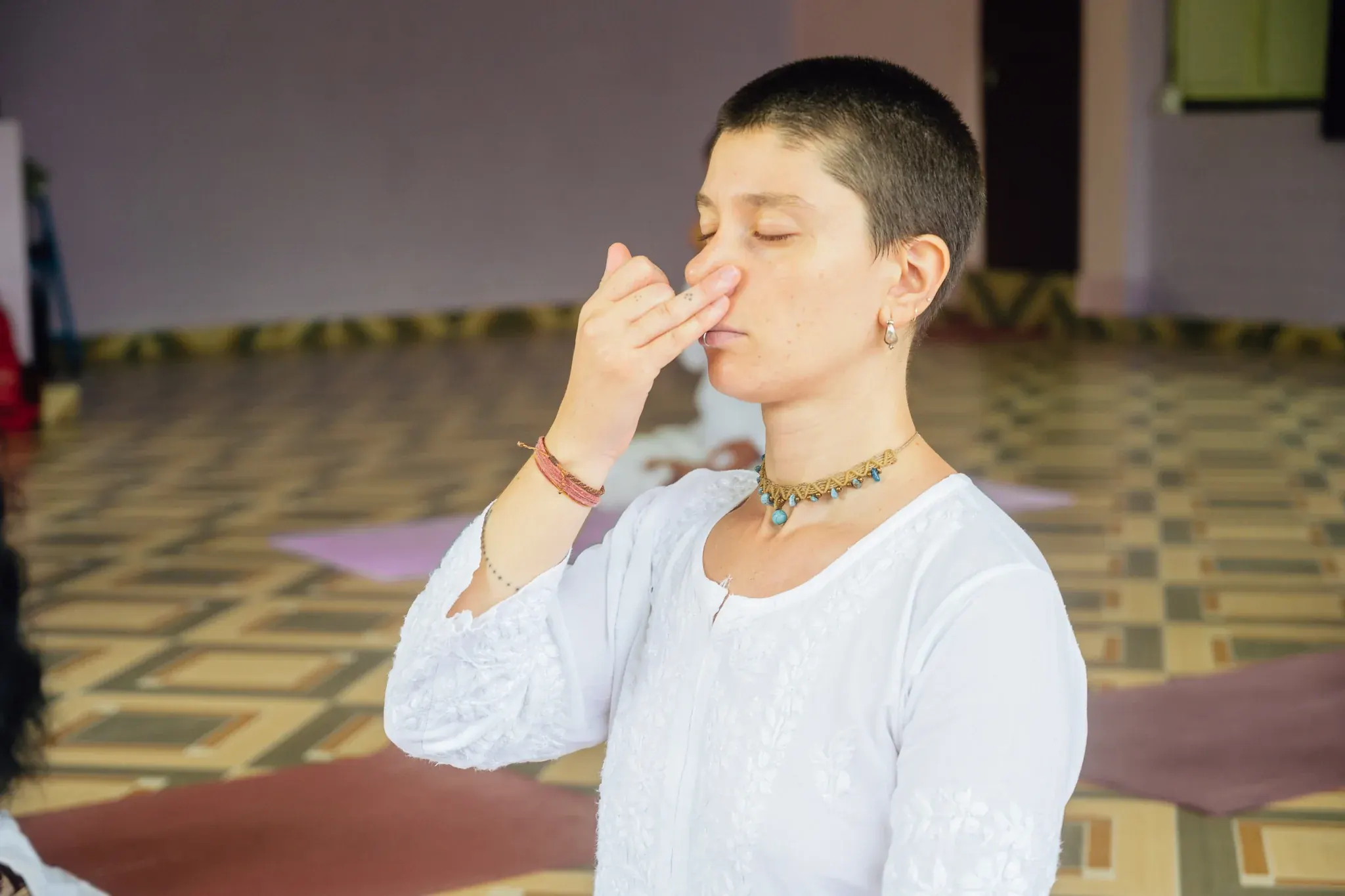
Kumbhaka is the deliberate holding of the breath in yoga. Antar kumbhaka is held in, after an inhalation; bahya kumbhaka is held out, after an exhalation. Classical texts also describe kevala kumbhaka, a pause that arises without effort. Retention is learned gradually, with short, comfortable holds, and is traditionally joined to the bandhas, yoga's energy locks.
리시케시에서 배우기7일 프라나야마 코스 첫 주에 배웁니다
The word and the practice
What is kumbhaka?
The Sanskrit kumbha means a pot or a jar. As a pot holds water, kumbhaka holds the breath: it is the pause in which you neither breathe in nor breathe out. Yoga describes the breath in three phases: pūraka, inhalation; recaka, exhalation; and kumbhaka, retention.
In the hatha yoga texts, retention is so central that its name stands for pranayama itself. The Haṭha Yoga Pradīpikā calls its eight classical breathing practices the eight kumbhakas, and treats each as a form of retention with its own way of breathing in and out. Six of the eight have their own guides here: Surya Bhedana, Ujjayi, Sheetkari and Sheetali, Bhastrika and Bhramari.
Kumbhaka is not a test of how long you can go without air. The same text says that when the breath moves, the mind moves, and when the breath is still, the mind becomes still. Students often notice their attention steadying during a calm hold; a strained hold does the opposite.
Two ways to hold
Antar and bahya kumbhaka
Antar means inner. In antar kumbhaka the breath is held in, after an inhalation. Most people find a held-in breath easier to keep calm, so it is usually learned first.
Bāhya means outer. In bahya kumbhaka the breath is held out, after a complete exhalation. It tends to feel stronger, and it is introduced only once antar kumbhaka is steady. Uddiyana bandha, the upward abdominal lock, needs the lungs to be empty, which is why it belongs to this retention.
Patañjali’s Yoga Sūtra (2.50) uses the related words bāhya, external, and ābhyantara, internal, for the movements of the breath in pranayama.
Antar kumbhaka
- Meaning
- Internal retention
- When
- After a full inhalation
- Lungs
- Comfortably full
- Bandhas, as commonly taught
- Jalandhara bandha, with Mula bandha
- Usually learned
- First
Bahya kumbhaka
- Meaning
- External retention
- When
- After a complete exhalation
- Lungs
- Comfortably empty
- Bandhas, as commonly taught
- Uddiyana bandha, with Mula and often Jalandhara bandha
- Usually learned
- Once antar kumbhaka is steady
| Aspect | Antar kumbhaka | Bahya kumbhaka |
|---|---|---|
| Meaning | Internal retention | External retention |
| When | After a full inhalation | After a complete exhalation |
| Lungs | Comfortably full | Comfortably empty |
| Bandhas, as commonly taught | Jalandhara bandha, with Mula bandha | Uddiyana bandha, with Mula and often Jalandhara bandha |
| Usually learned | First | Once antar kumbhaka is steady |
Retention without effort
Kevala kumbhaka: the breath held alone
Antar and bahya kumbhaka are deliberate: you choose when to hold and when to let go. The Haṭha Yoga Pradīpikā calls retention of this kind sahita kumbhaka, retention joined to inhalation and exhalation. Toward the end of its second chapter it describes a second kind, kevala kumbhaka, retention ‘alone’: the breath held with ease, without a deliberate inhalation or exhalation. The text advises practising sahita until kevala is attained.
Kevala kumbhaka is described as a fruit of long practice, not a technique to perform. Patañjali points in a similar direction: after the external and internal movements of the breath, Yoga Sūtra 2.51 names a fourth pranayama that goes beyond both. Many teachers connect that fourth with kevala kumbhaka. Either way, it cannot be forced, and no beginner’s routine should try to produce it.
Retention and the locks
Why kumbhaka is practised with the bandhas
A bandha, a lock, is a deliberate, steady hold at one point of the body: the throat, the abdomen or the pelvic floor. In the hatha tradition, retention and the locks belong together. The locks give the held breath a steady shape, so that the hold is contained rather than pushed.
The Haṭha Yoga Pradīpikā says that drawing up from below, contracting the throat and drawing the middle of the body back turns prana into the central channel. Today the pairing is usually taught as shown here.
- Jalandhara bandha, with antar kumbhaka
- The chin lock. After the inhalation, the chin is lowered toward the chest and the throat gently contracted. The Pradīpikā places it at the end of inhalation. Raise the head before you breathe out.
- Uddiyana bandha, with bahya kumbhaka
- The upward abdominal lock. With the lungs empty, the abdomen draws in and up under the ribs. The Pradīpikā places it at the end of retention, as the exhalation begins; today it is most often taught with the breath held out.
- Mula bandha, through both
- The root lock. A gentle lift of the pelvic floor, held through the retention whether the breath is in or out.
Held together, the three are called Maha bandha, the great lock: a later stage. Schools differ on the order in which the locks are applied. What matters is that they are released, and the head raised, before the breath moves again. Each lock is explained step by step in our guide to the bandhas.
Step by step
A first, gentle practice
A short practice that introduces antar kumbhaka, the breath held in, without strain. Read the safety notes first, and learn with a teacher if you can. The holds are short enough that no lock is used; the bandhas are added later, one at a time, with a teacher.
Prepare
Practise on an empty stomach, ideally in the morning, in a quiet, airy room. Sit in a steady cross-legged posture or on a chair, with the spine upright and the shoulders soft. Rest the hands on the knees.
Settle the breath
Close the eyes and breathe naturally through the nose for a minute or two. Then let the breath become slow and full, without forcing it, for a few rounds.
Breathe in and pause
Breathe in slowly through the nose to a comfortable fullness, not to the very top. Then pause gently with the breath in. Keep the throat soft, the face relaxed and the shoulders down.
Hold briefly
Hold only for a count that is easy, a few seconds to begin with. The hold should feel calm from start to finish. If you want to gasp, it was too long.
Breathe out slowly
Release the hold and breathe out slowly and smoothly through the nose, taking a little longer than the inhalation. The breath should never burst out; if it does, shorten the next hold.
Recover
Take two or three natural breaths before the next round. Practise five to ten rounds, then sit quietly for a minute and notice the state of the breath and the mind.
Build up slowly
Over weeks, not days, let the hold lengthen only while every round stays calm. Add a ratio, and later bahya kumbhaka and the bandhas, with a teacher's guidance.
Counting the breath
Ratios: count gently, increase slowly
A ratio gives the inhalation, the hold and the exhalation a set number of counts each. Choose a count that suits your breath; the examples below use four.
1 : 1 : 2
- Example count
- In 4, hold 4, out 8
- When
- A common first ratio, once a short, untimed hold is comfortable.
1 : 2 : 2
- Example count
- In 4, hold 8, out 8
- When
- Only when 1 : 1 : 2 is effortless for many rounds and many days.
1 : 4 : 2
- Example count
- In 4, hold 16, out 8
- When
- Often cited in traditional teaching. An advanced ratio, reached over a long time and under guidance; not a target for home practice.
| Ratio | Example count | When |
|---|---|---|
| 1 : 1 : 2 | In 4, hold 4, out 8 | A common first ratio, once a short, untimed hold is comfortable. |
| 1 : 2 : 2 | In 4, hold 8, out 8 | Only when 1 : 1 : 2 is effortless for many rounds and many days. |
| 1 : 4 : 2 | In 4, hold 16, out 8 | Often cited in traditional teaching. An advanced ratio, reached over a long time and under guidance; not a target for home practice. |
Two rules matter more than any number. The exhalation stays longer than the inhalation, so the breath never has to rush out. And a count is useful only while every round stays calm: when it is not, go back to the previous ratio. Bahya kumbhaka is usually kept shorter than antar kumbhaka for a long time.
Safety
Who should not practise kumbhaka
Holding the breath, especially with effort, changes the pressure inside the chest and abdomen, and it can bring up strong feelings. Kumbhaka is not suitable for everyone, and this guide is not medical advice. If any of the following applies to you, do not practise retention on your own: consult your doctor first, and tell your teacher before any class.
- Pregnancy
- High blood pressure
- Heart conditions
- Recent surgery, especially to the abdomen, chest, eyes or head
- Glaucoma or raised eye pressure
- Epilepsy
- Serious psychiatric conditions
Panic disorder or severe anxiety: breath-holding can set off panic in some people. If you have panic attacks, keep to gentle, untimed pauses under guidance, and stop at the first sign of distress.
Wait until you are well if you have a fever, a cold or any acute illness. Never practise retention while driving, in water, or anywhere a dizzy spell could be dangerous.
Stop at once and breathe normally if you feel dizzy, light-headed, breathless, a headache, chest discomfort, or pressure in the eyes or ears.
What goes wrong
Common mistakes
Holding too long
If the next breath bursts out or you gasp, the hold was too long. The exhalation tells you whether the retention was right.
Filling the lungs to bursting
Breathe in to a comfortable fullness, not to the last drop. A strained inhalation makes a strained hold.
Bearing down
Pushing down against a closed throat while the breath is held, as if straining. Keep the abdomen and the head free of pressure.
Tension elsewhere
A clenched jaw, a frown, raised shoulders. Only the bandha itself should be firm; everything else stays soft.
Breathing through a lock
Release the locks, and raise the head, before you breathe out or in again.
Learning the locks without a teacher
Retention with the locks is easy to get subtly wrong. Learn it with a teacher who can watch you practise.
Classical sources
What the texts say
यथा सिंहो गजो व्याघ्रो भवेद्वश्यः शनैः शनैः । तथैव सेवितो वायुरन्यथा हन्ति साधकम् ॥
yathā siṃho gajo vyāghro bhaved vaśyaḥ śanaiḥ śanaiḥ | tathaiva sevito vāyur anyathā hanti sādhakam ||
As a lion, an elephant or a tiger is tamed only slowly, little by little, so the breath is brought under control by steady practice. Otherwise it destroys the practitioner.
- Haṭha Yoga Pradīpikā, chapter 2
- Names the eight kumbhakas, pairs Jālandhara and Uḍḍīyāna bandha with retention, distinguishes sahita from kevala kumbhaka, and insists that the breath is mastered gradually.
- Yoga Sūtra 2.49–2.51
- Pranayama is the regulation of the movement of inhalation and exhalation, once a steady seat is established (2.49). Its external, internal and suspended movements are regulated by place, time and number, and become long and subtle (2.50). A fourth goes beyond the external and the internal (2.51).
- Gheraṇḍa Saṃhitā, chapter 5
- Another hatha yoga manual. Its own list of eight kumbhakas ends with kevalī.
Verse numbers differ slightly between editions of the Haṭha Yoga Pradīpikā. Translations on this page are our own plain renderings.
Lower Tapovan, Rishikesh
Learning kumbhaka in Rishikesh
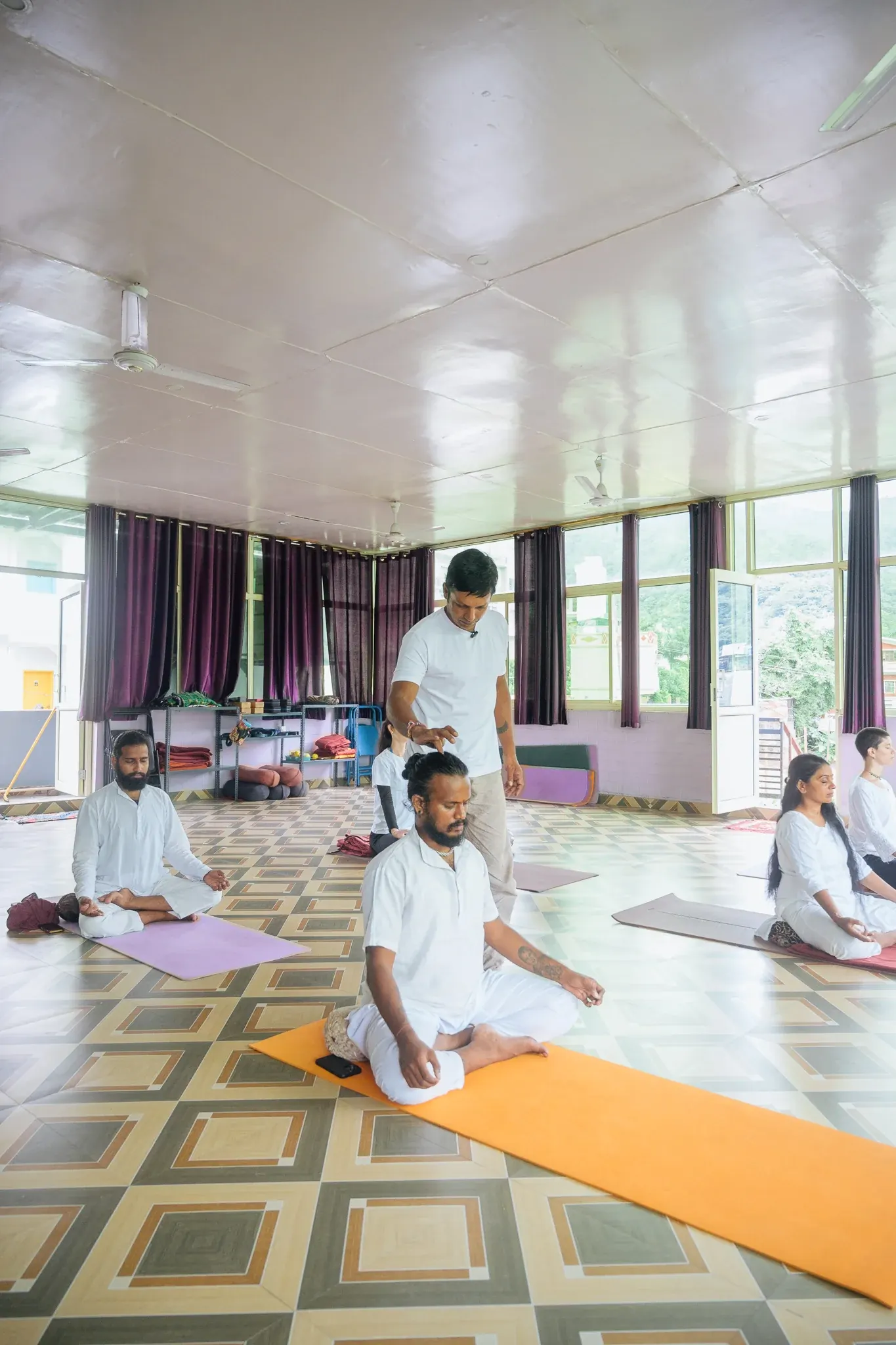
At Anantadrishti Yoga in Lower Tapovan, Rishikesh, beside the Ganga, antar and bahya kumbhaka with the bandhas are part of the first week. Retention starts with short, comfortable holds and is never forced.
Each teaching day has two sessions. The 07:30–09:00 session is for practice. The 11:30–13:00 session covers corrections, practice, and the science and philosophy of pranayama. In the second week, the 15-day course continues the retentions within the combined bandha practices.
Throughout, students observe how each practice influences the mind, the nervous system, the body and the energy.
Advanced Pranayama Course
Go deeper: kumbhaka with the bandhas, taught in Rishikesh
Antar and bahya kumbhaka with the bandhas are taught from the first week of our advanced pranayama course, alongside Nadi Shodhana, Agnisara and the three bandhas.
- Practice 07:30–09:00
- Study 11:30–13:00
- A new start every month
TuitionUS$149₹13,000
Questions
Kumbhaka: frequently asked
What is kumbhaka in yoga?
What is the difference between antar and bahya kumbhaka?
What is kevala kumbhaka?
How long should a beginner hold the breath?
Is kumbhaka safe? Who should avoid it?
Why is kumbhaka practised with the bandhas?
What ratio should I use for kumbhaka?
Where can I learn kumbhaka in Rishikesh?
Keep reading
Related pranayama guides
- The Bandhas: Yoga's Energy LocksThe three locks and Maha bandha, step by step.
- Nadi ShodhanaAlternate-nostril breathing, often the first place for retention.
- Surya & Chandra BhedanaSingle-nostril breathing; Surya Bhedana is a classical kumbhaka.
- Ujjayi PranayamaThe victorious breath, another classical kumbhaka.
- Bhastrika PranayamaThe bellows breath, traditionally completed with a retention.
- Types of PranayamaThe classical kumbhakas and other techniques.
All pranayama guides: Every technique guide, from Kapalbhati to Bhramari.