Fundamentals
5 Breathing Exercises for Beginners: Start Your Practice Today
Step-by-step instructions for 5 beginner-friendly breathing exercises: Box Breathing, 4-7-8 Technique, Diaphragmatic Breathing, Alternate Nostril Breathing, and Ujjayi. No experience needed.
SomeshApril 2, 20269 min read
You do not need years of training, special equipment, or a meditation cushion to start a breathing practice. These five techniques are accessible to complete beginners, can be done anywhere, and many people notice a difference within minutes. Each one suits a different need — from settling stress to winding down for sleep to sharper focus.
If you want to understand the broader landscape first, start with our guide on breathwork techniques. Otherwise, pick one exercise below and try it right now.
1. Box Breathing (4-4-4-4) — Stress Relief & Focus
Box Breathing (also called Square Breathing) uses equal-ratio breathing that many people find calming and focusing. It was popularised through US Navy SEAL training and is used by some first responders and athletes to keep their composure under pressure.
How to Practice
- Sit comfortably with your back straight. You can also practice standing or lying down.
- Inhale slowly through the nose for 4 counts.
- Hold the breath for 4 counts. Stay relaxed — do not clench your jaw or tighten your shoulders.
- Exhale slowly through the nose for 4 counts.
- Hold the breath out for 4 counts.
- Repeat for 4–8 rounds (approximately 2–4 minutes).
Duration: 3–5 minutes
When to use: Before a presentation, during a stressful moment, when you need to focus, or any time you feel overwhelmed. The equal ratios give a sense of control and predictability that many people find steadying when stress feels chaotic.
Pro tip: Once comfortable with 4-count box breathing, try 5-5-5-5 or 6-6-6-6 for a deeper effect.
2. The 4-7-8 Technique — Sleep & Deep Relaxation
Popularised by Dr. Andrew Weil and rooted in the pranayama tradition, the 4-7-8 technique uses an extended exhale, which is thought to favour the parasympathetic (rest-and-digest) nervous system. Many people use it to wind down before sleep.
How to Practice
- Sit or lie down comfortably. Place the tip of your tongue against the ridge behind your upper front teeth.
- Exhale completely through the mouth, making a whoosh sound.
- Inhale quietly through the nose for 4 counts.
- Hold the breath for 7 counts.
- Exhale completely through the mouth (with the whoosh sound) for 8 counts.
- This is one cycle. Complete 4 cycles to start, building to 8 cycles over time.
Duration: 2–4 minutes (4–8 cycles)
When to use: 10–15 minutes before bed, when you cannot fall asleep, during nighttime waking, or any time you need deep relaxation. The extended exhale (twice the length of the inhale) is the key — a long exhale is thought to engage the vagus nerve, which helps slow the heart rate. It can help you settle, but it is not a treatment for insomnia.
Important: If holding for 7 counts feels uncomfortable, reduce all counts proportionally (e.g., 2-3.5-4) and build up gradually.
3. Diaphragmatic Breathing — Anxiety & Daily Practice
Diaphragmatic breathing (also called belly breathing) is the most fundamental breathing technique and the foundation of all advanced practices. Most people breathe shallowly into the chest; this exercise retrains you to use the diaphragm — the large, dome-shaped muscle designed for breathing.
How to Practice
- Lie on your back with knees bent, or sit comfortably with feet flat on the floor.
- Place one hand on your chest and one on your belly.
- Inhale slowly through the nose for 4–6 counts. Focus on pushing your belly hand upward. Your chest hand should stay relatively still.
- Exhale slowly through the nose or mouth for 6–8 counts, feeling the belly hand lower.
- Continue for 5–10 minutes.
Duration: 5–10 minutes, ideally twice daily
When to use: Every day as a foundation practice, when you feel anxious, before meals as a way to slow down, or as a warm-up before other breathing techniques. Slow diaphragmatic breathing is thought to engage the vagus nerve, and a small 2017 study in Frontiers in Psychology found lower cortisol in healthy adults after eight weeks of regular practice.
Why it matters: Many people under stress breathe shallowly into the chest. Relearning to breathe with the diaphragm is simple, free, and one of the easiest habits to build.
4. Alternate Nostril Breathing (Anulom Vilom) — Balance & Harmony
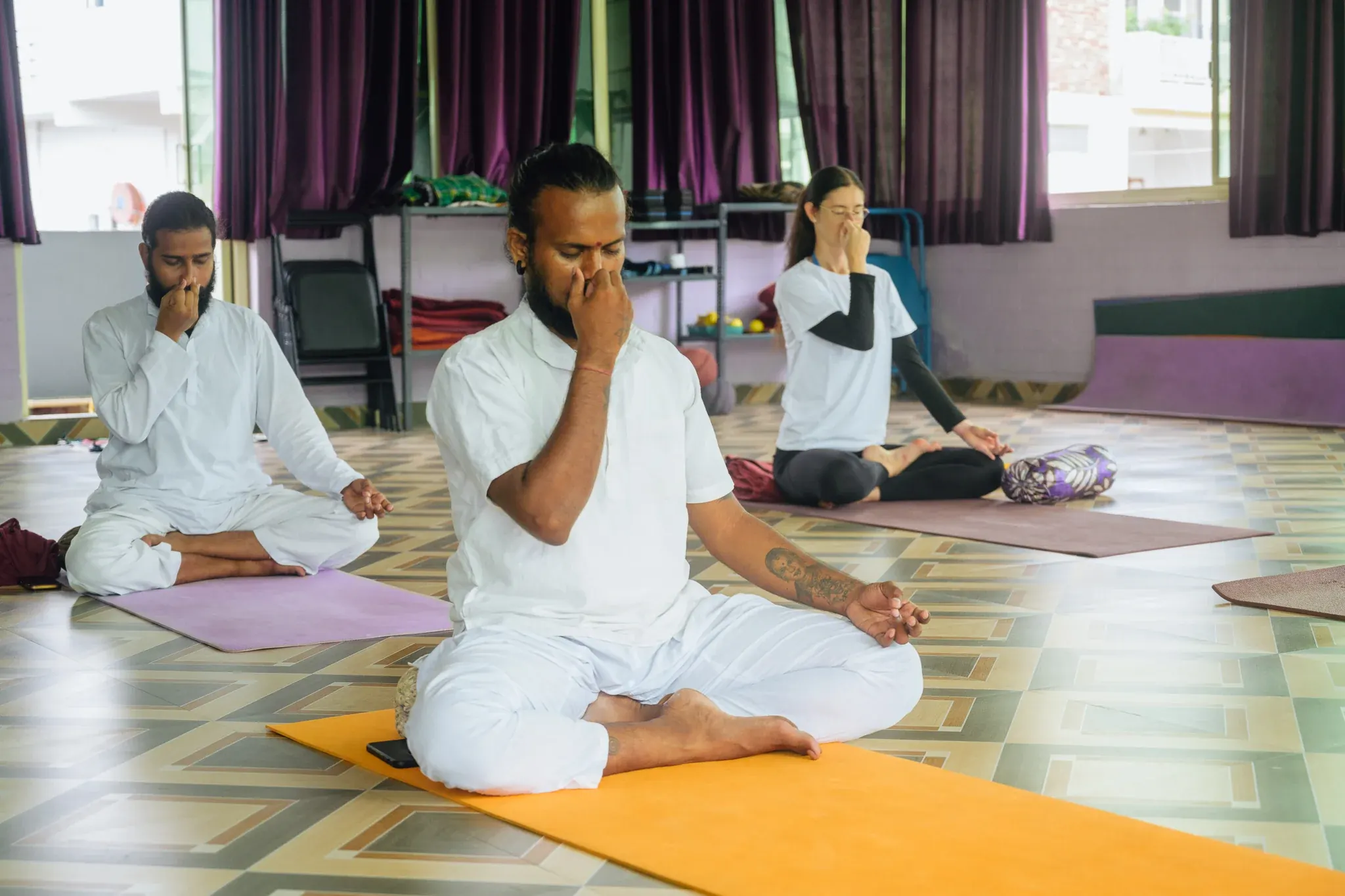
Alternate Nostril Breathing is one of the more studied pranayama techniques. Yoga describes it as balancing the two sides of the body and mind, studies suggest slow alternate-nostril breathing may help balance the two branches of the autonomic nervous system, and many people find it deeply centring.
How to Practice
- Sit comfortably with the spine tall.
- Bring your right hand to your nose. Use your thumb to close the right nostril and your ring finger to close the left nostril. (The index and middle fingers can rest on the forehead or fold toward the palm.)
- Close the right nostril with your thumb. Inhale through the left nostril for 4 counts.
- Close both nostrils. Hold briefly (1–2 counts).
- Release the right nostril. Exhale through the right for 4 counts.
- Inhale through the right nostril for 4 counts.
- Close both nostrils. Hold briefly.
- Release the left nostril. Exhale through the left for 4 counts.
- This completes one round. Complete 5–10 rounds.
Duration: 5–15 minutes
When to use: Morning practice for a balanced start to the day, before meditation, when feeling emotionally unbalanced, or during transitions between activities. Some small studies report modest short-term drops in blood pressure and in feelings of anxiety after alternate-nostril breathing; results vary, and it does not replace medical care.
For the complete technique with advanced variations, see our detailed Anulom Vilom guide.
5. Ujjayi (Ocean Breath) — Meditation & Inner Focus
Ujjayi Pranayama creates a soft, ocean-like sound through gentle throat constriction. The sound serves as a meditation anchor — it gives the mind something to focus on, making it far easier to maintain attention than silent breathing. The name means “victorious breath,” signifying victory over mental distraction.
How to Practice
- Sit comfortably with the spine erect and eyes closed.
- Begin breathing through your nose. Slightly constrict the back of your throat — as if you were fogging a mirror, but with the mouth closed.
- You should hear a soft, whispering or ocean-like sound on both the inhale and the exhale.
- Inhale for 4–6 counts, maintaining the sound throughout.
- Exhale for 6–8 counts (slightly longer than the inhale), maintaining the sound.
- Continue for 5–15 minutes, keeping the sound gentle and continuous.
Duration: 5–20 minutes
When to use: During meditation, before sleep, while doing yoga asana, or any time you want to cultivate deep, sustained focus. Many practitioners find it brings a calm, alert state of mind that suits both practice and creative work; small studies link slow breathing of this kind with more Alpha brain-wave activity.
Common mistake: Making the sound too loud or harsh. If someone across the room can hear you clearly, the constriction is too strong. The sound should be audible primarily to you — like a distant ocean or the sound inside a seashell.
For the full technique including advanced variations with bandhas, see our complete Ujjayi guide.
Building Your Daily Practice
You do not need to practice all five every day. Here is a simple framework:
| Time of Day | Recommended Exercise | Duration |
|---|---|---|
| Morning | Alternate Nostril Breathing or Ujjayi | 5–10 min |
| Midday | Box Breathing (when stress builds) | 3–5 min |
| Evening | Diaphragmatic Breathing | 5–10 min |
| Before bed | 4-7-8 Technique | 2–4 min |
Start with one technique that addresses your most pressing need. Practice it consistently for one week before adding a second. Consistency matters far more than variety — five minutes daily will outperform thirty minutes once a week.
What Comes Next?
Once these five techniques feel natural, you are ready for the deeper practices of classical pranayama:
- Kapalbhati (Skull-Shining Breath), a classical cleansing practice that many find energising
- Bhramari (Humming Bee Breath), a humming breath many people find settling when anxious
- Ujjayi with breath retention for meditative depth
Every advanced practitioner began exactly where you are now — with a single conscious breath.
These exercises are general information, not medical advice. If you are pregnant, or have a heart, blood-pressure, respiratory or psychiatric condition, consult your doctor first, keep the breath holds short or leave them out, and stop if you feel dizzy.
Go deeper: All Breathwork Techniques | Anulom Vilom Guide | Ujjayi Pranayama
CategoryFundamentals
Advanced Pranayama Course
Go deeper: a breathwork course rooted in classical pranayama
- 7, 15 or 30 days
- A new start every month
- Taught in English
Tuition fromUS$149₹13 000